Electricity from a clap
One hand is Teflon tape, the other bottle plastic. Every clap moves charge through a wire and flashes his LED eyes.

 IIT Mandi
Fun Lab preview
Open to everyone, with no class and no sign-in. In the first toy, Gajju the cardboard elephant claps two waste materials together and the electricity lights his eyes. Then see where the same effect is used, from recycling plants to a shoe that counts steps.
Workspace preview. Coming soon.
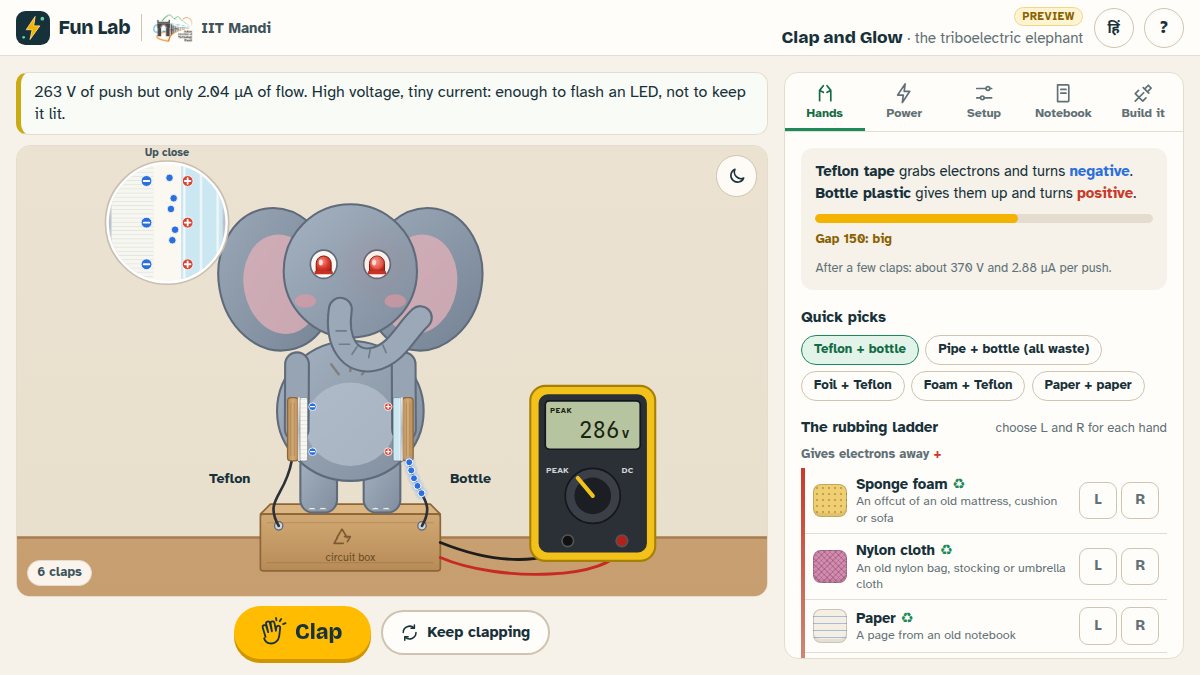
One hand is Teflon tape, the other bottle plastic. Every clap moves charge through a wire and flashes his LED eyes.
Eleven materials, most of them from waste, sit on a rubbing ladder. Pairs far apart move the most charge, and a notebook compares every pair you try.
Send the charge through a bridge into a capacitor or supercapacitor, watch it fill with a time machine, then light the eyes from it.
A guide to the real toy from cardboard, foil and old plastic, with honest numbers: high voltage, tiny current. In English and Hindi.
Recycling plants rub mixed plastic flakes so PVC and PET pick up opposite charges, then sort them between charged plates. Photocopiers charge their toner by rubbing too.
Try a shoe with the two materials in its insole. Each step makes a pulse that a tiny chip counts, and pulses that are too weak get missed.
Researchers use the same effect in smart floors, touch keys and health wearables, where a step, a press or a breath makes its own signal.
It makes far too little power to charge a phone. Battery-free switches save up many presses, and sea-wave farms would need very many generators.